


Ditch Mold
Your Professional Ditch Mold Supplier
The company is committed to providing high-quality cement product molds for many enterprises at home and abroad. Over the years, with a professional technical team, strict quality control and unremitting pursuit of innovation, it has established a good reputation in the industry.It has successively produced: cement pipe molds, septic tank molds, inspection well molds, retaining wall molds, box culvert molds, bridge slab molds, rainwater collection well molds, cable trench and canal molds, and various special-shaped component molds.
-
![Rectangular Groove Mold]() Rectangular Groove MoldThe Rectangular groove mold is a key type of drainage trench mold, primarily used to produce precast rectangular drainage channels. Constructed from high-quality engineering plastics or steel,...read more
Rectangular Groove MoldThe Rectangular groove mold is a key type of drainage trench mold, primarily used to produce precast rectangular drainage channels. Constructed from high-quality engineering plastics or steel,...read more -
![U-shaped Groove Mold]() U-shaped Groove MoldThe U-Shaped Groove Mold is a specialized forming system for manufacturing precast U-shaped drainage or irrigation channels. Constructed from high-strength steel or engineering-grade plastics,...read more
U-shaped Groove MoldThe U-Shaped Groove Mold is a specialized forming system for manufacturing precast U-shaped drainage or irrigation channels. Constructed from high-strength steel or engineering-grade plastics,...read more -
![Canal Mold]() Canal MoldCannl molds are specialized tools for manufacturing precast channel components of various shapes and specifications. Their design and production integrate functional requirements, hydraulic...read more
Canal MoldCannl molds are specialized tools for manufacturing precast channel components of various shapes and specifications. Their design and production integrate functional requirements, hydraulic...read more -
![Flume Mold]() Flume MoldFlume molds are specialized tools for manufacturing precast concrete channel components of various configurations. Engineered with hydraulic performance, structural integrity, and durability...read more
Flume MoldFlume molds are specialized tools for manufacturing precast concrete channel components of various configurations. Engineered with hydraulic performance, structural integrity, and durability...read more -
![Farmland Irrigation Canal Mold]() Farmland Irrigation Canal MoldDesigned for farmland irrigation, emphasizing water-saving, leak-proofing, and terrain adaptability. Compatible with border / check / sprinkler / drip irrigation to enhance efficiency.read more
Farmland Irrigation Canal MoldDesigned for farmland irrigation, emphasizing water-saving, leak-proofing, and terrain adaptability. Compatible with border / check / sprinkler / drip irrigation to enhance efficiency.read more -
![Rectangular Cable Trench Mold]() Rectangular Cable Trench MoldRectangular cable trench mold are specialized formworks for mass-producing reinforced concrete cable trenches. Utilizing advanced design concepts and precision manufacturing, these molds enable...read more
Rectangular Cable Trench MoldRectangular cable trench mold are specialized formworks for mass-producing reinforced concrete cable trenches. Utilizing advanced design concepts and precision manufacturing, these molds enable...read more -
![Precast Cable Trench Mold]() Precast Cable Trench MoldThese specialized molds feature modular designs and smart manufacturing to mass-produce standardized precast cable trenches with ±2mm accuracy and ≥25MPa strength.read more
Precast Cable Trench MoldThese specialized molds feature modular designs and smart manufacturing to mass-produce standardized precast cable trenches with ±2mm accuracy and ≥25MPa strength.read more -
![U-shaped Cable Trench Mold]() U-shaped Cable Trench MoldSpecialized for U-shaped cable trenches with curved structural optimization (radius R=1.5–3m) and dual drainage / cable protection functions.read more
U-shaped Cable Trench MoldSpecialized for U-shaped cable trenches with curved structural optimization (radius R=1.5–3m) and dual drainage / cable protection functions.read more -
![Arched Cable Trench Mold]() Arched Cable Trench MoldThe arched cable trench mold is a professional forming equipment specifically designed for manufacturing reinforced concrete arched cable trenches. Utilizing three-dimensional curved surface...read more
Arched Cable Trench MoldThe arched cable trench mold is a professional forming equipment specifically designed for manufacturing reinforced concrete arched cable trenches. Utilizing three-dimensional curved surface...read more -
![Cast-in-Place Cable Trench Mold]() Cast-in-Place Cable Trench MoldThis modular formwork system features high-strength alloy steel frames and adjustable panels. Optimized stiffness (deflection ≤1/500) and quick-disassembly systems enable high-quality forming of...read more
Cast-in-Place Cable Trench MoldThis modular formwork system features high-strength alloy steel frames and adjustable panels. Optimized stiffness (deflection ≤1/500) and quick-disassembly systems enable high-quality forming of...read more


Why Choose Us
Quality Assurance
For more than 20 years, the company has always adhered to innovation and development, continuously introduced advanced production technologies and equipment to improve production efficiency and product quality.
Production Equipment
Equipment produced by the company is Laser cutting machine, lathe, milling edge machine, milling machine, plate rolling machine, round rolling machine, bending machine, shearing machine, press machine, welding machine, sawing machine, wire cutting, plasma cutting.
Production Market
The company In China, it covers the eastern, central, western and northeastern regions. Internationally, products are exported to Asia, Africa, Europe and other places.
Our Service
Our team of experts will recommend the most suitable products according to customer needs and provide detailed consultation, we ensure timely delivery, and we provide long-term service support.
Advantages of Ditch Mold
Ensuring Standardized Construction: Ditch Mold provide a fixed shape and size, ensuring a consistent cross-sectional shape during construction. This ensures that gutter design requirements are met, improves construction quality, and reduces variations.
Improving Construction Efficiency: Using a Ditch Mold simplifies the construction process and reduces gutter production time. Compared to manual construction, moulding is more efficient, improving construction efficiency and saving manpower.
Ensuring Drainage Performance: Ditch Mold ensure that the gutter has the correct cross-sectional shape, ensuring effective drainage. Moulds can be selected in different shapes and sizes to meet the drainage requirements of different applications.
Improving Project Quality: Using a gutter mould avoids deviations and errors during construction, ensuring that the cross-sectional shape and dimensions of the gutter meet specifications. This helps improve project quality and reduces construction defects and repair costs.
Paramenters
|
Parameter |
Technical Indicator |
Remarks |
|
Production Efficiency |
• Monolithic: 10–15 units/day |
Varies by process |
|
Demolding Cycles |
≥500 cycles |
Heat-treated critical parts; 8–10yr lifespan |
|
Compressive Strength |
≥25MPa (Trench body) |
C30–C40 concrete grade |
|
Impermeability |
P8–P10 |
Joint test pressure ≥1.0MPa |
|
Dimensional Tolerance |
• Length: ±3mm |
CNC machining precision |
|
Auxiliary Equipment |
Vibration Platform (0–40Hz) |
Motor power: 15–30kW |
Key Features Of Ditch Mold
Corrosion-Resistant Carbon Steel Construction
With a corrosion-resistant carbon steel body, this mold ensures long-lasting durability in harsh outdoor environments. The galvanized coating prevents rust and degradation, outperforming traditional uncoated steel molds by ~30% in corrosion resistance.
Modular Customization for Flexible Applications
With a modular design, you can easily adjust the mold dimensions to create U-shaped ditches tailored to specific project requirements. Supports customization for both residential and commercial drainage systems, offering 20+ standard size options.
High-Efficiency Precast Concrete Production
With optimized mold geometry, achieve rapid and uniform concrete curing, reducing production time by up to 40% compared to manual casting methods. The concrete channels produced meet industrial-grade thickness and structural integrity standards.
Dual-Scenario Adaptability
Designed for both residential and commercial drainage needs, this mold produces channels capable of handling moderate to heavy water flow. The reinforced concrete structure ensures stability in urban settings while resisting debris buildup, unlike basic plastic molds.
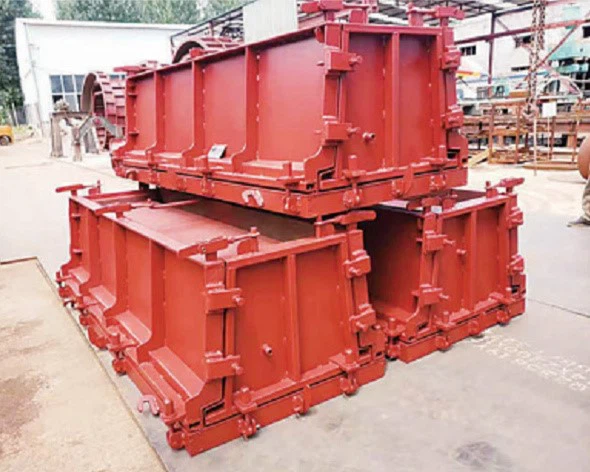
Building ditch molds calls for several materials selected depending on the intended use and the type of product being produced. Common materials have different qualities and include steel, aluminum, and other alloys. Because of its strength and wear resistance, steel is sometimes chosen for big-volume manufacture. For lower-volume applications and prototyping, aluminum is appropriate since it is lightweight and easier to process. The material choice affects the performance, longevity, and cost-effectiveness of the mould, so producers can customize ditch molds to fit their particular requirements. Composite materials are progressively employed to improve moulding capabilities and lower environmental impact as technology develops.
Step-by-Step Process of Ditch Mold
Prepare the Area
Clear the trench using a shovel or backhoe. Remove vegetation, loose soil, rocks, and debris to create a stable base.
Level the Ground
Use a spirit level and grading tool to ensure the trench bottom is flat and properly sloped for water runoff.
Position the Mould
Place the U ditch mould into the trench, aligning it with adjacent sections. Confirm it is level and securely positioned.
Pour the Concrete
Mix concrete to the recommended ratio and pour gradually into the mould using a wheelbarrow and shovel. Avoid overfilling.
Smooth the Surface
Use a trowel or screed board to level the top edge, ensuring it’s flush with the mould for a clean finish.
Cure the Concrete
Allow at least 24–48 hours for initial curing. Keep the surface moist by misting with water to prevent cracking.
Municipal Stormwater and Sewage Management
U-shaped ditch molds, with their curved cross-section design, reduce the water flow resistance coefficient to 0.013-0.018, improving drainage efficiency by 20%-30%, effectively alleviating urban flooding. Oval ditch molds are suitable for landscape areas such as parks and wetlands, integrating drainage with aesthetics through their streamlined structure.
Public Space Safety Maintenance
Slotted ditch molds, with their narrow slit design, quickly collect rainwater from areas like sidewalks and parking lots, reducing the risk of slippery surfaces and achieving a leakage rate of less than 1%.
Road Drainage System Construction
Rectangular trough molds (40-60cm wide, compressive strength ≥20MPa) are laid along the side of the road to quickly divert road runoff and prevent roadbed erosion. U-shaped grooves in the central median resist vehicle loads, ensuring driving safety.
River and Reservoir Management
The galvanized surface of the rapids trough mold offers a salt spray resistance of ≥1000 hours, making it suitable for use on steep slopes or in areas with high flow rates, preventing structural damage caused by erosion.
Emergency Flood Response
Modular molds enable the construction of kilometer-long temporary drainage channels within 24 hours, and standardized mortise and tenon joints ensure rapid response to flood disasters.
FAQ
We're well-known as one of the leading ditch mold manufacturers in China. Please feel free to buy bulk high quality ditch mold made in China here from our factory. For customized service, contact us now.