

If you’ve ever worked on a drainage project—whether it’s a small side street runoff fix, a big highway expansion, or a residential development—you know that one size rarely fits all when it comes to concrete culverts. I get it, because I’ve been in the cement box culvert mold game for years, answering the same question over and over: “Can we actually get a mold made just for our project?” The short answer is yes, but let’s break down why custom molds matter, how they work, and why skipping “off-the-shelf” stuff can actually save you time, money, and headaches in the long run.
First off, let’s talk about why standard molds fall short. I’ve seen so many projects where someone grabbed a pre-made mold because it was fast, only to realize halfway through that it’s too narrow for the required flow rate, too short to span a ditch without extra supports, or the corners are too rounded for a construction site that needs tight, precise alignment. A lot of new builders or even some smaller contractors don’t realize that cement box culvert molds aren’t one-size-fits-all. Every project has unique specs: soil type, water volume, local code requirements, even the space you have to work on site. That’s where customization steps in.
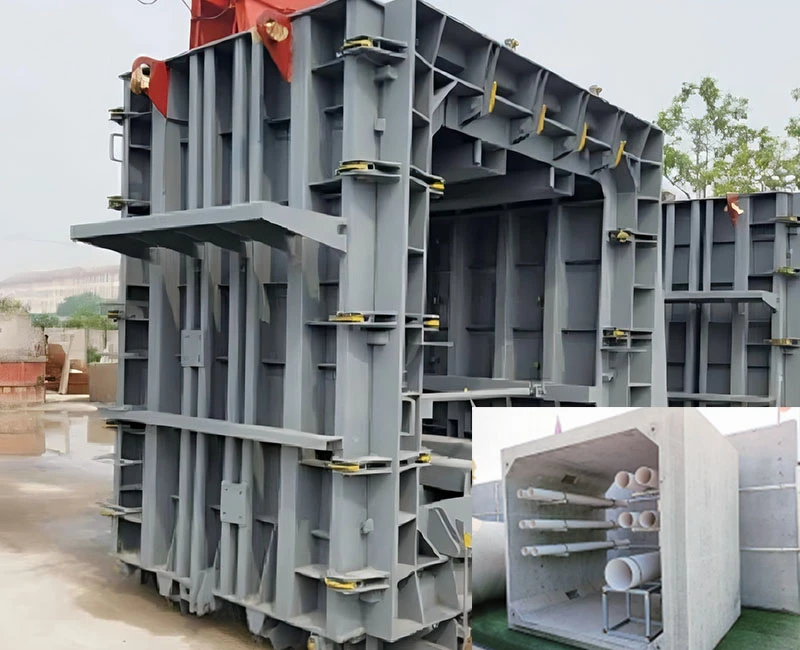
Let’s start with the basics: what a custom cement box culvert mold actually does. It’s a reusable steel mold (usually high-grade steel that can handle repeated concrete pours and heavy construction equipment) that shapes wet concrete into the rectangular or square box culverts you’ll see underground. Off-the-shelf molds work for basic, straight-line projects where the dimensions are cookie-cutter, but if you’re dealing with a curve in a road, a varying ditch depth, or a site that needs a culvert that integrates with existing drainage pipes, you need something tailored. For example, if your project is in an area with heavy flooding, you’ll need a mold that produces a culvert with a larger internal cross-section than standard sizes—something you can’t get from a pre-made mold. Or maybe your site has limited access, so you need a mold that can be broken down into smaller, transportable pieces, rather than a big, bulky single unit that’s hard to haul in.
Wait, but what about the existing molds we offer? We do have standard options, like the Cast-in-Place Box Culvert Mold, which is great for permanent installations where you pour concrete directly into the mold on site. Then there’s the Rectangular Box Culvert Mold, perfect for straight, rectangular culverts that fit most small to medium projects. We also have Circular Box Culvert Mold for projects that need a round interior for better water flow, and Culvert Pipe Mold for those cases where you need a pipe-style culvert instead of a box. But even with all those standard options, we still get requests daily for something that doesn’t fit those specs. That’s because even if a standard mold is close, it might not hit exactly what your project needs.
So how does the customization process work? Let’s walk through it like we would with a new customer, because that’s how we do it—no weird jargon, just clear steps. First, you reach out to us (we’ll get to that later) with your project details. We need things like: the internal dimensions you need (length, width, height), the wall thickness of the culvert, any special features—like lifting points that make it easier to move the pre-cast culvert once it’s cured, or taper for projects that need the culvert to get wider or narrower at one end, or even a special coating on the mold to make the concrete release easier (super helpful if you’re doing multiple pours). We also ask about your site conditions: how far the mold needs to be transported, how many times you’ll reuse it (for multiple culverts on the same site), and any local building codes that require specific strength or dimensions.
Once we have that info, our engineering team (not some fancy, disconnected group—they’ve been building these molds for 15+ years) designs the custom mold. We use 3D modeling to make sure every part fits right, so when you get the mold, there are no surprises—no gaps where concrete could leak, no parts that don’t line up when you assemble it. Then we build the mold in our shop using high-tensile steel, which is key because it needs to hold up under the pressure of wet concrete (that pressure is no joke—you’d be shocked how much force wet concrete exerts). We also do test fittings before we ship it out, so if something’s off, we fix it right here, not on your construction site.
I know what some of you are thinking: “Custom stuff is way more expensive, right?” Let’s get real. At first glance, a custom mold might seem pricier than a standard one, but when you factor in the time you’ll save, the cost of fixing mistakes with a standard mold, and how long a custom mold lasts, it’s actually a better deal. Here’s an example: last year, we worked with a contractor on a highway project in a rural area. The standard mold we had was 8 feet wide, but their project needed 8 feet 6 inches, plus it had to have a built-in support beam halfway up the wall to handle the weight of heavy semi-trucks. They tried renting a standard mold first, but it didn’t have the support beam, so they ended up spending extra money adding temporary supports to the finished culvert—costing them an extra $12,000 and delaying their project by 3 days. When they switched to our custom mold, it was a little more upfront, but they saved money on the extra supports, finished on time, and the mold lasted them for 12 more culverts on a nearby project. So in the end, the custom mold paid for itself twice over.
Another big plus with custom molds: flexibility for future projects. If you’re a contractor who does a lot of drainage work, a custom mold built for a recent project can be adjusted or reused for similar jobs. We also offer modifications—if you have a mold that worked well, but you need a slightly larger dimension next time, we can tweak the design instead of making a whole new mold. That’s another way we keep costs down for our customers.
Wait, but is there any case where a custom mold isn’t necessary? Yeah, if your project is super simple—like a small residential driveway culvert that’s 4 feet wide, straight, no special features. Then a standard mold will work just fine. But for anything that’s more than basic, customization is worth considering. Let’s say you’re working on a bridge approach, where the culvert needs to connect to existing bridge abutments. The dimensions have to be exact, otherwise you can’t bolt them together. A standard mold might be off by an inch, which would mean wasting concrete, extra work to trim the culvert, and delays. A custom mold ensures that every measurement is spot-on, so everything lines up perfectly.
I also want to talk about quality control, because that’s something that matters a lot to us. When we build a custom mold, we don’t cut corners. We use steel that’s thick enough to handle repeated pours—no flimsy stuff that bends after a few uses. We also add features that make your job easier, like quick-release mechanisms so you can take the mold apart fast once the concrete is cured, or reinforced edges so you can move the mold with a crane without damaging it. We’ve had customers tell us that their custom mold from us has lasted 20+ pours, which is way longer than some standard molds they’ve used in the past. That’s because we build custom molds to meet your specific needs, not just a generic “one size” that might not hold up.
Let’s address a common misconception: some people think custom molds take forever to make. Yeah, if you go to a place that only does custom work from scratch, it might take 4-6 weeks, but with us? We have a streamlined process. Usually, we can get a custom mold designed and built in 2-3 weeks, and sometimes even faster if you’re in a pinch. We know construction projects have deadlines, so we prioritize timely delivery without skipping on quality. We’ve shipped molds to jobsites across the country, even to remote areas, and we make sure they arrive on time, ready to use.
Another thing we love about custom molds is that they let our customers innovate. We’ve worked with a few smaller developers who wanted culverts with rounded corners instead of sharp ones, because rounded corners don’t trap debris as easily, which means less maintenance over time. We designed a custom mold for them, and now they use that design on all their projects. That’s the cool part about this job—we don’t just sell molds, we help our customers solve their specific problems. Whether it’s a mold for a small farm drainage ditch or a big industrial project, we listen to what you need and make it happen.
If you’re still on the fence about custom vs. standard, ask yourself a few questions: Are the standard molds’ dimensions close enough, or will I have to do extra work to make them fit? Will a standard mold handle the weight of the traffic or water flow on my site? Do I have space on my site for a bulky standard mold, or do I need something that can be assembled on site? If the answer to any of these is “no,” then a custom mold is probably the way to go.
At the end of the day, cement box culvert molds aren’t just metal boxes—they’re tools that make your project successful. Using the wrong mold can lead to delays, extra costs, and even safety issues if the culvert doesn’t hold up over time. A custom mold is an investment that pays off in less downtime, better results, and a finished project that meets all your requirements.
If you’ve got a project that needs a mold (even if you’re not sure if it’s custom), reach out to us. We’re here to walk you through every step, answer any questions, and make sure you get the right mold for your job. No pressure, no sales pitch—just straight talk from a guy who’s been in this game long enough to know what works.
Now, let’s make this clear: when you contact us, we’ll work with you to figure out exactly what you need, whether that’s tweaking a standard mold or building something totally custom. We’ve helped everyone from small local contractors to big national construction companies, and we’ve seen firsthand how the right mold can make a project go from stressful to smooth.
Don’t let a one-size-fits-all mold mess up your next project. Customization isn’t just a luxury—it’s a smart move for any construction job that needs a culvert that fits perfectly. And if you need a standard mold for a simple project, we’ve got those too, like the ones linked here: the Cast-in-Place Box Culvert Mold, Rectangular Box Culvert Mold, Circular Box Culvert Mold, and Culvert Pipe Mold. But when you need something that’s made just for you, we’re the ones to call.
References

- National Precast Concrete Association. (2022). Custom Mold Design for Precast Concrete Structures. NPCA Construction Guidelines.
- American Society of Civil Engineers. (2021). Drainage Infrastructure: Customization vs. Standardization. ASCE Journal of Construction Engineering.
- Concrete Pipe & Precast Association. (2023). Steel Mold Durability for Repeated Culvert Production. CPPA Technical Report.