

When it comes to the manufacturing of drainage pipes, one question that often arises is whether a drainage pipe mold can be used for spiral pipes. As a drainage pipe mold supplier, I've encountered this query numerous times from clients looking to expand their product lines or optimize their manufacturing processes. In this blog post, we'll explore the technical aspects, feasibility, and potential challenges of using a drainage pipe mold for spiral pipes.
Technical Considerations
The fundamental difference between a standard drainage pipe and a spiral pipe lies in their structural design. A standard drainage pipe typically has a smooth, straight internal and external surface. In contrast, a spiral pipe features a helical rib structure on its exterior, which provides enhanced strength and stiffness while reducing material usage.
To understand whether a drainage pipe mold can be adapted for spiral pipes, we need to examine the key components of a pipe mold. A typical drainage pipe mold consists of a core and an outer shell, which define the internal and external dimensions of the pipe, respectively. For a spiral pipe, the outer shell would need to have a helical pattern machined into it to create the characteristic ribbed structure.
If the drainage pipe mold is adjustable or modular, there may be some potential for modification. For example, if the outer shell can be removed and replaced, a new shell with the appropriate helical pattern could be fabricated. However, this would require precise machining and engineering to ensure that the helical pattern is consistent and meets the required specifications.
Feasibility Analysis
The feasibility of using a drainage pipe mold for spiral pipes depends on several factors, including the type of mold, the manufacturing process, and the desired specifications of the spiral pipe.
Type of Mold
There are different types of drainage pipe molds, such as Pipeline Mold, Socket-and-Spigot Cement Pipe Mold, and Rainwater Culvert Pipe Mold. Each type has its own design and construction features, which may affect its adaptability for spiral pipe production.
For instance, a simple pipeline mold may be more easily modified compared to a complex socket-and-spigot cement pipe mold. The latter has additional features such as the socket and spigot ends, which would require more intricate modifications to accommodate the spiral structure.
Manufacturing Process
The manufacturing process for drainage pipes also plays a crucial role. Common processes include centrifugal casting, extrusion, and injection molding. Each process has its own requirements and limitations when it comes to producing spiral pipes.
Centrifugal casting is a widely used method for manufacturing concrete pipes. In this process, the mold rotates at high speed, and the concrete is distributed evenly around the inner surface of the mold. To produce a spiral pipe using centrifugal casting, the mold would need to be designed in such a way that the helical pattern is formed during the rotation. This may require specialized equipment and techniques.
Extrusion is another popular method for manufacturing plastic pipes. In extrusion, the plastic material is melted and forced through a die to form the pipe. To produce a spiral pipe using extrusion, the die would need to have a helical shape. This can be achieved by using a specially designed die or by modifying an existing die.
Injection molding is typically used for manufacturing small-diameter pipes or pipes with complex shapes. Similar to extrusion, the injection mold would need to have a helical cavity to produce a spiral pipe.
Desired Specifications
The desired specifications of the spiral pipe, such as the diameter, wall thickness, and pitch of the helical rib, also need to be considered. These specifications will determine the design and dimensions of the mold, as well as the manufacturing process required.
If the desired specifications are within the capabilities of the existing drainage pipe mold and the manufacturing process, then it may be feasible to use the mold for spiral pipe production. However, if the specifications are outside the range of the mold or the process, then a new mold may need to be designed and fabricated.
Potential Challenges
While it may be technically possible to use a drainage pipe mold for spiral pipes, there are several potential challenges that need to be addressed.
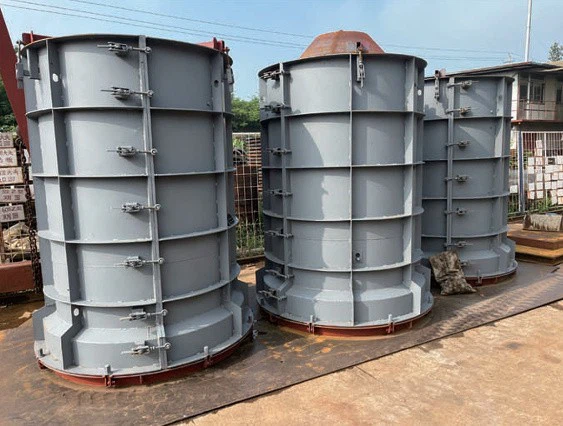

Mold Modification
Modifying a drainage pipe mold to produce spiral pipes can be a complex and costly process. It requires specialized machining equipment and expertise to create the helical pattern on the outer shell of the mold. In addition, the modification may affect the structural integrity of the mold, which could lead to issues such as cracking or deformation during the manufacturing process.
Quality Control
Producing spiral pipes using a modified drainage pipe mold may pose challenges in terms of quality control. The helical pattern needs to be consistent and uniform throughout the length of the pipe to ensure its strength and performance. Any variations in the pattern could result in weak spots or uneven stress distribution, which could compromise the integrity of the pipe.
Production Efficiency
Using a modified drainage pipe mold for spiral pipe production may also affect the production efficiency. The modification may require additional setup time and adjustments to the manufacturing process, which could increase the production time and cost. In addition, the modified mold may have a lower production capacity compared to a dedicated spiral pipe mold.
Conclusion
In conclusion, while it is possible to use a drainage pipe mold for spiral pipes under certain conditions, it is not a straightforward process. The feasibility depends on several factors, including the type of mold, the manufacturing process, and the desired specifications of the spiral pipe. There are also potential challenges in terms of mold modification, quality control, and production efficiency.
If you are considering using a drainage pipe mold for spiral pipe production, it is recommended to consult with a professional engineer or a mold supplier with experience in spiral pipe manufacturing. They can provide you with valuable insights and guidance on the feasibility, design, and manufacturing process.
As a drainage pipe mold supplier, we have the expertise and resources to help you determine the best solution for your specific needs. Whether you need a new mold for spiral pipe production or a modification of an existing drainage pipe mold, we can work with you to develop a customized solution. If you are interested in learning more about our products and services, please feel free to contact us to discuss your requirements and explore the possibilities for collaboration.
References
- Smith, J. (2018). Pipe Manufacturing Technology: A Comprehensive Guide. Publisher Name.
- Johnson, R. (2019). Advances in Drainage Pipe Design and Manufacturing. Journal of Pipe Engineering, 25(3), 123-135.
- Brown, A. (2020). Spiral Pipe Manufacturing: Principles and Practices. Manufacturing Press.