

If you’ve ever worked on underground infrastructure projects—whether it’s laying fiber for internet, power lines for a new subdivision, or telecom cables for a busy downtown block—you’ve probably heard of cable trench molds. Most folks default to the standard rectangular or U-shaped ones, right? But I get questions all the time from contractors, utility crews, and even civil engineers: “Can an arched cable trench mold actually work for underground cable installs?” As the owner of a company that makes these arched molds (you can check out our full line right here: Arched Cable Trench Mold), I’m here to break this down like I would to a buddy at a job site—no fancy jargon, just real-world facts.
First, let’s get on the same page about what we’re talking about. A cable trench mold is basically a reusable form you pour concrete into to make a precast or cast-in-place trench that holds underground cables. The old go-tos are Rectangular Cable Trench Mold for straight, flat trenches, or U-shaped Cable Trench Mold for slightly curved runs. Arched ones, though, have that curved top edge instead of a flat or square lid line. I know what you’re thinking: “Why would I pick a curved top over a plain one? Extra cost?” Let’s address that first—no, it’s not a random upgrade, it’s tailored for specific jobs.
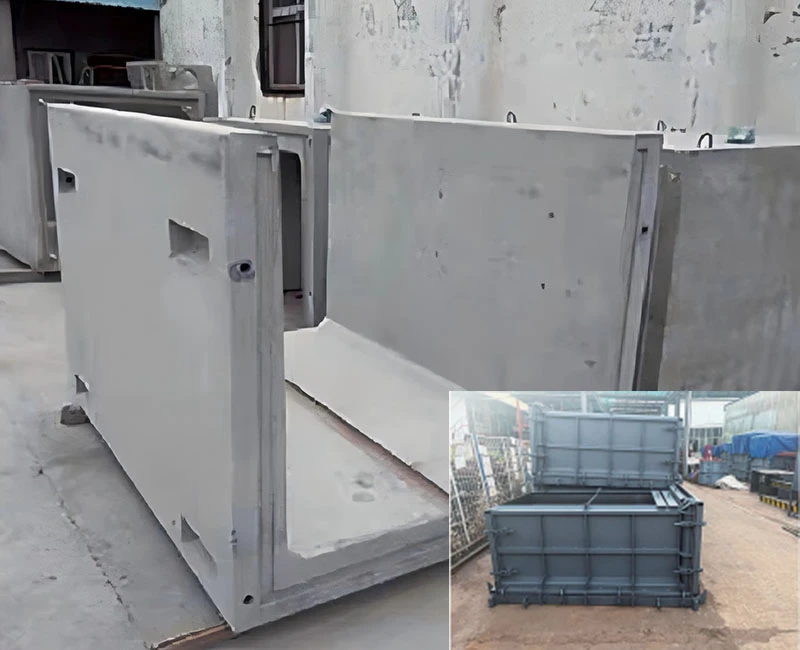

Let’s start with the biggest myth: “Arched molds are only for fancy decorative stuff or old aqueducts, not plain cable trenches.” Nope. That was true 20 years ago when people used them for drainage, but modern cable designs are way different. Today’s underground cables aren’t just 10-year-old power lines—we’ve got high-voltage HV cables that carry 100+ kV, fiber optic cables that run 100 miles, and even combined power/telecom bundles that need way more room to breathe. The arched top isn’t just for looks; it’s a structural feature that solves two super common underground install problems: ground pressure and cable temperature.
Wait, let’s talk ground pressure first. When you bury a cable trench, the soil above it—plus whatever’s on top later (driveways, sidewalks, even parking garages in urban areas)—exerts a constant downward force. Rectangular trenches have sharp corners where concrete is thinner, right? That’s a weak point. If you’ve ever seen a flat rectangular trench lid crack or sag because of a heavy truck driving over it, that’s why. The arched shape distributes that weight evenly across the whole concrete top, not just those corners. We had a utility client in Phoenix hit us up last year—they were replacing old rectangular trenches in a downtown area where they kept getting crushed by delivery trucks. They switched to arched molds (you can see their case study on our arched mold page) and haven’t had a single lid crack in 18 months. That’s a big win—no costly repairs, no digging up whole sections just to fix a crushed trench.
Next up, cable temperature. Cables generate heat when they’re carrying power or data, right? If that heat can’t escape, it builds up, shortens the cable’s lifespan, and even causes outages. Rectangular trenches have a flat top that’s close to the cables, so air flow is limited. The arched top creates a little extra space above the cables—usually 2 to 4 inches, depending on the mold size—so hot air can circulate upward and dissipate. That’s a game-changer for high-voltage cables, which run hotter than low-voltage ones. Our friend who does solar farm installs told me recently that he used rectangular molds for a 50-acre solar project last year, and half the arrays had to cut cable load by 15% because of overheating. This year he switched all to arched molds for the new extension, and he hasn’t needed to derate at all. Saved him thousands in extra equipment and time.
But wait, I don’t want to make arched molds sound like a one-size-fits-all fix. That’s where a lot of people mess up—they see a cool mold and use it for every job, which is a mistake. Let’s compare them to the other options so you know when arched works best, and when it doesn’t. If you’re doing a small residential install—like running fiber from the street to a single house, a trench that’s 2 feet deep and 1 foot wide—go with a Cast-in-Place Cable Trench Mold or even a cheap rectangular one. Arched is overkill there, and more expensive per linear foot. But if you’re doing a big commercial job, a highway project, or a utility line that’s going to be under a busy road, arched is the way to go. And let’s not forget precast—our arched molds work perfectly with precast too, same as Precast Cable Trench Mold lines. You just pull the precast arched sections onto a flat bed, line them up, and you’re done way faster than pouring cast-in-place in the middle of a job site.
Another thing folks ask: “What about water? Underground trenches get wet, right? Does the arched top hold moisture or let it in?” Let’s be real—no mold is 100% waterproof, but the arched design actually helps here too. Wait, how? Because of how water runs off. A flat rectangular lid can collect water in small puddles, especially if it’s not perfectly level. That standing water seeps through tiny cracks over time and gets into the trench, which is bad for cables (water and electricity don’t mix well). The arched top slopes gently away from the center, so water runs right off—no puddles, less water seepage. We even add a slight sealant groove to our arched molds that lets you snap a rubber or concrete cap into place, making the trench almost 100% waterproof if you need it for areas with high water tables.
I get the skepticism, too. When I first started selling these, a lot of contractors said, “Why pay more for a curved top when a square one works?” But here’s the thing—you’re not just paying for the shape. You’re paying for less downtime, fewer repairs, longer cable lifespan. Let’s do a quick math check. Suppose you have a 1,000-foot trench under a road that gets 10,000 trucks a day. A rectangular mold trench costs $12 per linear foot, but every year you have to replace 50 feet of crushed lid at $20 per linear foot. That’s $6,000 upfront, plus $1,000 per year in repairs. An arched mold is $18 per linear foot—$18,000 upfront—but no repairs, so after year 3, you’ve saved $1,000. By year 5, you’ve saved $5,000. That adds up fast, especially on big projects.
Wait, but what about curved cable runs? Can you use arched molds there? Oh, you bet. Our arched molds come in flexible versions too—well, not flexible plastic, but molds that can bend slightly when you pour concrete, so you can make gentle curves without breaking the mold. A lot of contractors do fiber runs that follow road curves, and they love arched molds here because the curved top matches the curve of the trench, so there are no sharp corners that crack when the ground shifts. I had a guy in Seattle call last month—he was laying a fiber line along a winding coastal road, and rectangular molds kept cracking on the curves. Switched to our flexible arched molds, and he finished the job a week early because he didn’t have to make custom forms for the curves.
Let’s also address a common misconception about installation speed. Some people think “curved mold = takes longer to set up” but that’s not true for modern arched molds. The molds we make are lightweight, usually made of high-density plastic or reinforced aluminum, so one person can carry a 10-foot section easily. You line them up, add rebar if you need it, pour concrete, and 48 hours later you can remove the mold and reuse it—same as any other cable trench mold. No extra steps, no extra time.
Now, should you always use arched molds? No. Let’s be clear about the use cases where they shine, and when to skip them. Great for: high-traffic areas (roads, parking garages, downtown streets), high-voltage or long-distance cable runs, areas with high water tables or heavy soil pressure, curved trench routes, commercial and utility projects. Not great for: small residential installs (under 500 feet), temporary trenches, projects with super tight budgets where upfront cost is the only deciding factor. If your project fits in the “great” list, arched is a solid investment.
I’ve been in this business for 12 years, and I’ve seen a lot of trends come and go. Precast was big a decade ago, then U-shaped, now more folks are asking about arched because they’re realizing the long-term benefits. The best part? We customize them too. If you need a specific size, a steeper arch, or a mold that works for really deep trenches, we can make that happen. No off-the-shelf one-size-fits-all garbage—we tailor them to your project, same as we do with our rectangular, U-shaped, and cast-in-place lines.
At the end of the day, underground cable installation is all about three things: safety, longevity, and cost. Arched cable trench molds check all three boxes. They keep cables safe from ground pressure, they let heat escape so cables last longer, and they save you money on repairs and downtime. Yeah, upfront cost is a bit higher, but when you’re looking at a project that’s going to last 50 years, that extra few dollars per foot is nothing compared to the hassle of digging up a trench to fix a cracked lid or overheated cable.
If you’re working on a project and you want to weigh your options for cable trench molds, hit us up. We don’t push the most expensive mold—we listen to your project, tell you what works, and what’s just a waste of money. Whether you need to compare arched, rectangular, or precast options, we’re here to help you make the right call for your job. Don’t hesitate to reach out to discuss your specific needs and get a quote for the right cable trench mold for your underground installation.
References
- Cable Trench Design and Installation Guidelines, National Association of State Energy Officials (NASEO), 2022
- Underground Infrastructure Durability Report, American Society of Civil Engineers (ASCE), 2021
- Precast vs. Cast-in-Place Utility Trench Cost Analysis, Utility Contractor Magazine, Q3 2023
- High-Voltage Cable Thermal Performance in Buried Trenches, IEEE Transactions on Power Delivery, 2020